Dog Days

After being gone two weekends in a row, I needed a restful (to use a polite term for lazy) weekend in Arusha.

I am thrilled to report that my attempts to speak Kiswahili are finally paying off (quite literally!). Hannah, Elise, and I walked to a nearby Maasai craft market on Friday where we were ambushed by vendors. The locals are accustomed to muzungu tourists only staying for a few days in Arusha and they are always pleasantly surprised when a muzungu can speak Kiswahili (or at least say more than Jambo! which is a greeting that we’ve avoided because it screams tourist). The numerous aisles of vendors quickly overwhelmed me. I spotted a group of older women making beaded jewelry under a tree nearby. As I approached, they greeted me in English and I responded in Kiswahili… (The formal greeting for elders is “Shikamoo”). I managed to hold a small and basic conversation with the women, during which I haggled for and bought three bracelets. As I was preparing to leave, the women kindly handed me four bracelets as a gift for their “muzungu friend.”

The freebies didn’t end there! Karla and I went on a 30-minute walk to a market that we had walked by several times. After perusing the merchandise (and in this case the merchandise was a plethora of avocadoes, bananas, carrots, broccoli, tomatoes, mangos, etc) I struck up a conversation in Kiswahili with an older woman. I bought a few avocadoes from her and then continued my hunt for tomatoes. As I was leaving, I heard my name being called and I looked up to see the same woman offering me three carrots at no cost. I politely and happily accepted the gift and promised to return. Whether offering freebies to muzungus is a strategic move or just a kind gesture, I cannot say. For my own purposes, I hope it’s the latter.

Even a “lazy” weekend in Arusha is never boring. After a failed attempt to study Saturday afternoon, I attended an International festival for music, dance, and food at the International School of Moshi. Our music professor encouraged us to attend because a famous group from Zanzibar would be playing traditional Taarab music, in addition to collaborations with local western musicians. As soon as I walked on to the grounds of the festival, I was in an International Studies major’s paradise. The Dutch were wearing wooden clogs on my right, the Germans were selling various beers to my left, and just around the corner, the Indians were draping people and saris and turning hands into beautiful works of art with henna. I was so over-stimulated, overjoyed, and overwhelmed that I didn’t know where to begin!

And then I saw it. The American booth. The immensely-ironic-completely-contrary-to-the-current-International-System-yet-still-rather-symbolic American booth. A piece of cloth bearing Barack Obama’s portrait was being used as a table cloth, on which a pan of hot dogs was sitting, looking vastly unappealing even to a hotdog lover like myself. No one was neither manning the booth nor attending the booth. Feeling oddly patriotic despite the pathetic display of American pride, I approached the booth. My eye was immediately drawn to a sign that read “Yes you can… Buy a hotdog!”. I laughed to myself and hoped that the foreigners at the festival know that there’s more to America than hotdogs and Barack Obama.

For being an International Festival in Tanzania, there were surprisingly few booths from the continent of Africa. I later learned that the booths were representing the countries that the students were from—most of which are either the children of UN workers or children of Safari lodge owners. I had the chance to walk around the grounds of the school for a while and it forced me to draw comparisons. I had recently taken a tour of the Arusha School where students are crammed into outdated and dilapidated classrooms. Just down the road, the classrooms at the International School were spacious, clean, and outfitted with computers, projectors, and laboratories. As I walked from classroom to classroom at the festival, I read the names of the teachers on the doors. Mrs. Wilson, Mrs. McBride, Mrs. Snow—all were clearly western names. There are very few “inbetweens” in Arusha—it is dominated by extremes. The gaps are large, often swallowing those at the bottom. It’s an ugly reality that I rarely face at Miami, but one that I literally meet face-to-face on a daily basis here.

We returned to our apartments after the music ended and were greeted with a very pleasant, fluffy, and adorable surprise…

A puppy!

Going against all study abroad advisers’ advice, we got a puppy! Her name is Jaala, which means fate in Kiswahili, and very appropriately so! Jaclynn, Ana, and Liana were driving to meet a friend in town when a tiny ball of fluff stumbled out of the bushes into their path. The puppy was undernourished, covered in bugs, and roaming around on the streets. The picked her up and found a woman who said they could have her in exchange for “soda money.” They handed her 5,000 shilling (about $4) and left. In a lucky turn of events, the friend who they were meeting had a sister who was a veterinarian and happened to be in Arusha for the weekend. They immediately went to see her and Jaala got all of her shots, an insecticide spray, and official registration as a pet. When I met Jaala for the first time, she was clearly exhausted from a long day of events, during which she went from being a street puppy to a muzungu’s puppy. Liana, who is here on a Fulbright documenting the interaction between elephants and humans, was planning on getting a puppy before she goes back to the states in December, so Jaala is the lucky puppy that gets to fill that role. In the meantime, we get to play with her and take care of her as our own.

Jaala made the week of midterm exam preparation much more enjoyable. Since we aren’t technically allowed to have Jaala at our accommodation, we would take her to ViaVia during the day where she could run (more like stumble) around. The Maasai have taken a particular liking to Jaala, and she has acquired a similar liking for them! Jaala has her own shuka that we wrap her up in, and even her collar is a beaded Maasai bracelet. Despite her African roots, Jaala has picked up American eating habits and I am convinced that her belly is twice the size as it was from when they first found her.

Besides Jaala, I’ve found a couple other ways to circumvent studying. On Friday afternoon, Roland invited us to pick-up basketball group that he coaches. For those of us who didn’t want to embarrass ourselves on the basketball court, there was a field where we could play Frisbee. Roland also brought his two kids, Radley (1) and Betsy (4). Among Radley, Betsy, and my new best friend Kelvin (6), I got the best workout I’ve had in months. Kelvin’s English was surprisingly good and we bonded immediately when he gave me his whistle to wear, and in exchange I gave him my sunglasses. I spoke to Radley and Betsy mostly in French, although they were both initially very shy. We jumped rope, kicked a soccer ball, played in dirt, and ran in circles from mid-afternoon until dusk when the basketball practice was finished. A pick-up soccer game was going on in the field next to ours and every once in a while goats would pass by, causing interference. I promised Kelvin that I’d return to play with him again soon. I gave back his whistle and he gave me back my sunglasses.

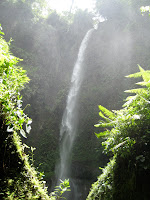
Pandora ain’t got nothin’ on Mt. Meru

I find it partially ironic and partially dismaying that James Cameron’s Avatar has been ubiquitous during my stay here in Tanzania. Two instances in particular stick out in my mind…

The first was during my home-stay with a member of a Maasai choir last weekend. Her name was Catherine and she was young, beautiful, and not Maasai. Despite being a member of a choir that sings in Maa and is predominantly composed of Maasai, Catherine came from a Chagga family. After a wonderful performance by the choir, I walked home hand-in-hand with a Chagga dressed in Maasai robes.

The walk home was dark and treacherous as the two of us were dodging banana leaves and potholes in the dirt road. A few lights from neighbors lit the way, but with 5-minutes left in our walk the electricity shut off. The first few times that the lights went off in Tanzania, my reaction was to go into mild panic mode… (I’ve never felt comfortable in the dark). Since this is a normal occurrence, now my reaction is to stop where I am and look up. When the lights go out, the stars are brighter than ever.

We finally arrived at Catherine’s house where I met her mother and her young brother, Peter. After eating a delicious traditional Tanzanian meal and spending my first night there, several things surprised me…

1. They were Chagga

2. They were Christian

3. They ate dinner at 9:30pm

4. They had a guest room just for me

And most of all,

5. They didn’t have a shower, but they had a washing machine (the only washing machine that Mr. Stubbs has seen in his 5 years here)

Needless to say, it was not the weekend that I had expected, but I wouldn’t have traded it for anything different. I went to bed on Friday night already feeling welcomed into Catherine’s family.

My Avatar experience began at 8am on Saturday. Mr. Stubbs (our music professor) organized for our group plus the members of the choir to hike to a waterfall in Mt. Meru.

In one of my first posts I mentioned that James Cameron should thank Arusha in his Academy Awards ‘Best Picture’ acceptance speech. Since he didn’t win the Oscar, I was only correct on one of those accounts. Nonetheless, I stand behind my previous statement even more now than before the hike. Despite my realization that Pandora is a fictitious land, I half-expected plants to glow when I touched them.

For the first 45 minutes we hiked straight up the mountain. We had a beautiful view of the city in which we’ve been living.

For the next part of the hike, I’m pretty sure we encountered most of the world’s biomes. There was grassland, rainforest, gorges, and even coniferous trees. Some of the locals showed us which berries were safe to eat along the way. The sun was shining and the ground was level, minimizing the level of falling potential.

As I learned from Avatar, the jungle plays tricks on those who enter it.

In order to get to the river where the waterfall was located, we had to hike down into the gorge, which is easier said than done. I had my eyes fixated on the ground to avoid plummeting until I heard a call from a monkey in a nearby tree. I was momentarily distracted and lost my footing, only to be saved by the Maasai in front of me (they’re super-human and never trip).

I made it down to the river and looked around for the trail. Unbeknownst to me, I was standing in it. We walked upstream for 35 minutes, potentially contracted various water-borne diseases. Whatever I may have contracted, the view was completely worth it. Drenched up to my knee in river water, I rounded the corner of a mossy rock and felt the power of the waterfall. The spray from the waterfall could be felt from several yards away, but the cool mist was welcoming to my sweat-drenched body.

We noticed a few people climbing up the rocks to stand on a natural platform underneath the waterfall. Thankfully, I had enough confidence in my step to attempt the slippery climb. I made it to the top and looked up at the tons of water falling directly over my head, close enough to touch.

As with most places we’ve gone, we were reluctant to leave. Little did we know that the hike back would be just as unique as the waterfall itself. The clouds released they’re very own waterfall ss soon as we reached the top of the gorge. Unlike most rains we’ve experienced, this one was consistent and heavy. Spirits remained high despite the fact that we were drenched from head to toe within fifteen minutes of the 3-hour hike back.

The trail quickly turned into a muddy river that was out to get us. I think it would’ve been more effective to sled down the mountain on a banana leaf, but others disagreed so we continued by foot.

The muzungus were falling left and right but the Maasai were masters of the land (per usual).

Catherine and I arrived at the front door of her house cold, dripping wet, and covered in mud. Catherine’s mom had a pot of boiling water on the fire waiting for my bath. The water was poured into a big bucket and I washed myself off as much as possible.

After bathing, Catherine and I sat around a small smoldering charcoal fire. As I learned, Tanzanians are very comfortable with silence. For two hours we sat, occasionally talked, and watched the rainfall.

That night we had a traditional Chagga meal for dinner. Catherine’s mom had prepared a large pot of banana stew with carrots, meat, and other goodies. Exhausted from the day’s activities, I went to bed.


After attending a 4-hour church service in Kiswahili with Catherine the next morning, I said goodbye to her and her family and headed back to Arusha with the beautiful blue and white kanga that they had given me tied around my waist. Catherine and I exchanged numbers and she promised me that she would teach me how to cook traditional Tanzanian food the next time I visit… she also made me promise that I would bring my dirty clothes to their washing machine. Those are two offers that are impossible to turn down.

The weekdays were full of class and schoolwork with fun interspersed at almost every moment. I can easily navigate through the streets of Arusha and I’ve also finally gotten the hang of daladalas (though I have not yet reached the point of mastering them).

Despite a heavy homework load and looming midterms, we all decided to attend a free showing of Avatar at ViaVia on Wednesday night. The first time I saw Avatar was in a sold-out 3-D-high-tech-high-definition-fancy-shmancy theater in Knoxville. The second time I saw Avatar was in a sparsely populated restaurant/bar with a Dutch pirated version of the movie being projected onto a full-sized sheet. Believe it or not, I think that I liked it the second time more. Both the movie and the subtitles were in English, but they rarely aligned. For example:

1. Jake Sully (the main character) translated into Jack Surrey

2. “Come to Papa” translated into “I’m coming, Daddy”

3. “The war is over” translated into “The weather was disappointing”

and the most outrageous of them all…

4. Avatar was “Affan an”… (seriously, it’s the name of the movie, how could you get it wrong?!)

Between the subtitles and the power spontaneously shutting off at pivotal points in the movie, my second time seeing Avatar was definitely unique. Not to mention the fact that at one point I looked around and saw a handful of Maasai warriors with shukas and machetes who seemingly looked apathetic towards the athletic abilities of the blue people of Pandora.

It was a paradox of epic proportions.

I’m noticing a trend.

If you thought Catholic weddings were long, try a Maasai wedding...

I looked around and was amazed. Looking back, four colors stick out in my mind: Brown for the dust. Blue for the sky. Red and purple for the hundreds of Maasai draped in shukas. True to their colors, they looked like royalty.

There are times when I just know to set my camera aside, plunge headfirst into the event unfolding around me, and hope that my mental pictures become just as permanent as a photograph itself. Today was one of those times.

We met Lalahe our first week in Arusha and we’ve been hanging out with him regularly ever since. The best way to get to know Lalahe is to go on a walk with him… “Maasai love to walk,” he said. So a couple of weeks ago on a walk, Lalahe and his friend Yacobo (known to muzungus as Jacob) invited us to Yacobo’s brother’s wedding. We were eager to accept.

After much anticipation, the day finally came for us to take our first visit to a Maasai village. We were all nervous that a group of 14 muzungus would feel awkward at a traditional Maasai wedding, but Lalahe insisted “100 muzungus are welcome!”.

And welcomed we were.

From the time that we arrived in the village in the afternoon (which was only a 45 minute daladala ride away from town) to the time that we left the village at dusk, I hardly felt like a foreigner. Women and children immediately welcomed us with handshakes, Maa (the Maasai language) greetings, and high-pitched chants (called an-gu-lu-lu in Maa). The children at first seemed shy, but as soon as we passed out the candy we brought them, all shyness disappeared. Saying that we “passed out” the candy is a loose term. We barely had time to open the bags of candy before kids came charging at us with outstretched hands. In less than a minute, the four bags of candy had been demolished, leaving behind only a few empty candy wrappers soon to be buried in the dust.

We had been told that the wedding would start at 3 o’clock. In America, that means to get to the church at 2:30 to get a seat. In Africa, that means to get to the village at 3:00, relax, sit under a tree, eat a full meal, and then begin the festivities a couple hours later.

So that’s exactly what we did.

An older Maasai woman with collars of beads around her neck ushered us into a boma (better known to Americans as little mud huts) where we sat on tin cans and passed around a cup of Maasai alcohol. According to one of Yacobo’s friends, the Maasai believe that the alcohol has the power to rid the body of its harmful diseases. If that’s true, then the old Maasai men carrying around huge buckets of the concoction won’t be dying anytime soon. Politely, I took a sip and passed the cup to the next person.

I squinted my eyes as I walked out of the shade of the boma into the ruthless sun. The dust had settled from our arrival and I finally had the chance to absorb the scene around me. Trees were sparse, cattle and goats were abundant. The bomas were spaced fairly far apart from one another, but still close enough to constitute a village. Someone asked Lalahe how much of the land was Maasai land and he responded, “as far as the eye can see, and even beyond the mountain.” I questioned myself as to whether or not that was a direct quote from Mufasa in The Lion King.

Despite that it is currently the rainy season, Tanzania is still in the midst of a severe drought that has nearly devastated crops and cattle. Lalahe said that his father lost over half of his family’s cattle to drought and disease this year alone. As we walked from the boma to the nearest tree (about a football field away) I noticed the effects of the drought for the first time. Lalahe said the ground is usually green where we were walking, but instead I was kicking up dust. I looked at the vast plains around me and saw dust storms resembling small tornados forming.

We headed for the nearest tree that provided just enough shade to shield all of us (plus several Maasai men) from the sun. There weren’t many trees in the area, but under each one that was there I could see the vibrant red and purple colors of Maasai gathered underneath. We sat under the tree for about half an hour, relaxing and watching the cattle graze. At one point some of the Maasai guys found entertainment in chasing a goat around.

Speaking of goats, Yacobo and his friends brought all of us our own bowl of rice, grilled bananas, and goat meat as a special celebration dish for the wedding. By the time Yacobo handed me my dish, it was covered in dust and flies because the walk was so long between the boma and the tree. Nonetheless, I took it with a smile. And so there I was, a muzungu girl from Tennessee sitting in the middle of the African bush eating goat meat with Maasai warriors.

Each of us had enough food in our bowl to feed three to four people and we were afraid that we’d offend them if we didn’t finish most of our food. The first few bites were delicious until I realized that I was full with over half of a bowl still left unfinished. I looked around and considered my options. I could a) offend the people who gave me the food… and who also have machetes around their waist b) inconspicuously feed it to a rogue cow or c) finish the plate myself. Before I had time to decide which option I would choose, I looked up and saw a dust storm headed straight for our tree. I immediately turned to the Maasai, hoping that their pastoral instincts would know what to do. One said “Run!”, another said “Cover up!”, and a third yelled something in Maa. I closed my eyes, covered my food, and hoped that the food that I had eaten was substantial enough to keep me grounded. Thankfully, 20 seconds later I was still on the ground, unharmed but quite dusty. And then we continued to eat our food.

After our meal, Lalahe took us to a ring of acacia branches where he said the warriors would be performing (the acacia branches are very sharp so it protects them from dangerous wildlife). At this point we had thrown all conventions about western weddings out of the window because it was clear that this was more of a celebration with singing and dancing than an actual ceremony. Six of the men gathered (along with Ben, who they invited to join in the dance) and they began to walk in seemingly arbitrary circles in the distance, occasionally waving their staffs around. As they slowly approached the place where we were standing, I could hear a low, grumbling chant. We got in line behind the men and entered the circle of acacia branches for the rest of the dancing and singing. We formed a circle and the warriors began to chant to a new tune, more upbeat than the former one. The men would hop into the center of the circle one at a time, jump three or four times, smack the ground with their feet, and then return to their original position. The Maasai are known for their vertical jump, and it was incredible to witness it. This exchange continued for about 45 minutes until the rest of the women entered the circle. There was clearly no structure to the festivities and at this point I was still unsure who the bride and groom were. The women formed their own circle and began to sing their own song.

The women and men were in separate circles for another 45 minutes when they slowly and naturally convened. I had been so distracted by the jumping, singing, chanting, and dancing that I noticed for the first time two large groups of girls; one group was draped in long solid purple shukas, and the other group in red shukas. They were all wearing layers and layers of white beads around their necks, on their heads, in their ears, and around their waists. They really did look like magnificent African princesses.

Two of the girls in purple stood out from the others because they had beads that were delicately draped over their faces. As I later learned, this was a celebration for two couples instead of just one, and these were the brides! They didn’t make a grand entrance or demand any attention. They just blended in with everyone else, save for the extra beading that made this day theirs.

The cattle grazed. The men jumped. The women sang. The children played. And everyone (maybe even the cows) danced.

The most vivid mental picture I took was of the silhouettes of Maasai warriors bobbing up and down as the sun was dwindling and the clouds had cleared just enough to see Mt. Kilimanjaro.

The dancing and singing continued until dusk when we had to leave the circle of acacia so the cattle could enter to be protected for the night. I paused for a second to think of how I would feel if I were kicked out of church on my wedding day so that cows could get a good night’s rest.

Although we were reluctant to leave, the setting sun was hastening our departure. Lalahe said that the singing and dancing would continue for another few hours. I said goodbye to the children that had latched on to me and headed back to town with a lot on my mind to write.

Turning Twenty in Tanzania

A week has passed since my last post and yet I’ve had so much to write about! Where to begin…

Ah, yes, my birthday! It was pleasant to walk outside in the sunshine on my typically cold-weathered birthday. Even though I had class from 8am-6:30pm on Monday, there was still plenty of time for surprises! The timing couldn’t have been more perfect for the letters that I received from Cassidy and Amy. Just as I walked into class at 8am (exactly midnight on the East Coast!), Roland handed me these two items and I must confess that I choked back a few tears (but who cares, it’s my party and I’ll cry if I want to…). The entire group burst out into song and I soaked up every last note. I read the letters several times each and propped them up on my desk to admire.

Even class itself was enjoyable as we discussed the various organs and functions of the United Nations and UN peacekeeping missions in Africa. So far, so good and it was only 8am!

Roland’s class ended and out of the corner of my eye I saw Paul setting up delicious-looking treats. I went to investigate the enticing situation and I saw ‘Kelsey’s Bday’ spelled out on homemade banana cupcakes! Despite my dislike for banana flavored foods that aren’t actually bananas, the cupcakes were delicious! I ate the K, the B, and apostrophe, and then reluctantly (but still happily) shared the rest with my friends.

I even had a surprise waiting for me on the daladala ride to music class… a whole seat to myself! Sure, our daladala did breakdown halfway to class (even after a 30-second stop at a gas station where they filled the gas tank while the vehicle was still on and moving…) but that’s just another birthday adventure!

After we finally made it to Makumira for music, Mr. Stubbs had caught wind that it was my birthday. Mr. Stubbs always has interesting views on American and East African culture because he has lived in both places for extended periods of time. He told us that birthdays in Tanzania are not a big deal… there isn’t even a phrase for ‘Happy Birthday’ in Kiswahili (instead they say “Hongera!” meaning, “congratulations”). Furthermore, most food is cooked over a stove, so a baked cake is considered a delicacy and is typically only eaten as weddings or confirmations. This little tidbit of information came in handy later that night.

The clock struck 7:00 and I headed with the group to Pepe’s Italian and Indian restaurant for my birthday dinner. The food was good, but the entertainment was unforgettable. Since the ratio of muzungus to Africans was about 3:1, I sensed that this place was definitely featured in tourism brochures. That was the first sign that something odd would happen. The second sign was when we saw three men sneaking about in the background dressed in various animal prints. And then the production began. The men tumbled, juggled, limbo-ed, and mimed for an awkwardly long time for an awkwardly silent crowd. Nonetheless, the awkwardness was what made the show memorable… well, that, and they forced Ben to limbo under a flaming pole.

I had eavesdropped (or dropped some eaves, as Samwise Gamgee would say) and had heard rumors that a cake was waiting for me back at the apartments. So we finished our dinner and walked back. I kept myself occupied for a few minutes while they were “cleaning the room” aka lighting the candles (I’m smarter than you think, my friends). Once the “room was clean” I walked in and the group burst out into song again and handed me a huge cake that said “Happy Birthday Butter Baby”… (the butter is heavenly here and my cholesterol has probably skyrocketed as a result). I was so delighted that I almost forgot to make a wish when I blew out the candles. There was still cake left after all of our stomachs were full, so, remembering what Mr. Stubbs had told us about the value of a good cake, Elise had the wonderful idea to offer some to the staff of our accommodation. I suppose one could say that I had my cake and shared it too.

To be honest, I had low expectations for my birthday. I anticipated a few well wishes here and there, not anything more. But the love that I received from here and from home was far more valuable than any physical gift. In the last few hours of my birthday, I even had the chance to Skype with Mom and Kimberly, which put the sprinkles on my already iced cake.

The delicious banana cupcakes, made from scratch!

The bevy of gifts that I got from the states!

The Rain Reigns

The rainy season has come with a vengeance to assail the thirsty, dust-ridden land. Instead of falling, the rain angrily smacks the ground, taking no mercy on any unsettled dust particle. It sounds more like a round of applause than a pitter-patter, occasionally complemented with a Boom Boom (but rarely a Pow).

The rain has come every day since the prompt onset of the appropriately named season. One minute the sun will be shining, and all of a sudden a few raindrops or a clap of thunder will warn you to take shelter before the impending downpour. An hour later, the rain will have passed, leaving behind only a few puddles.

I have yet to be inconvenienced by the rain, despite being caught in potentially inconveniencing positions.

Even though I didn’t have class on Thursday, Roland assigned us 300 pages to read on various peacekeeping missions and security in Africa, so a few of us headed to a café for tea and reading. Our plan had been to stay for two hours or so, then head back. Unbeknownst to us, the rain had been plotting against our American Time the whole time. Just as we were about to pay the check, we smelled the rain coming… then we saw the clouds… then came the warning raindrops… and finally, the rain. We were a 20-minute walk away from our apartment and vastly unprepared. So we embraced it. We packed up our books, closed our laptops, sat back in a cushioned half-bed half-couch on the covered porch of the café, and relaxed. I’d be lying if I denied falling victim to public napping that afternoon. The rain eventually passed and Hannah, Karla, and I walked home, dodging puddles along the way.


Getting caught in the rain isn’t an inconvenience either. In fact, it can be quite welcoming. After International Law on Friday, Paul (the Australian in our group who has lived in Arusha on several occasions previously) took 7 of us to his house en route to Food Water Shelter, an eco-friendly orphanage in the middle of nowhere. After a 25-minute walk, a 20-minute daladala ride on a dirt road (during which 7 of us fit in a seat made for 3 people), and another 15-minute walk, we arrived at Paul’s house. The village where it is located is known for “village justice,” which is used by some locals. We passed one of Paul’s friends on the way and they muttered in Kiswahili to each other. When we were in the safety of his house, Paul later told us that some of the guys were addressing “village matters”. I wasn’t exactly sure what that meant, but I had a faint idea based on the hesitation in Paul’s expression. We re-energized before another long walk with passion fruit and mangos. Paul even let us invade his precious stash of VegeMite that he brought all the way from Australia. It tasted like overly salted pasty soy sauce. nom nom vom.

We went on a 35-minute walk to Food Water Shelter, and on the way we ran into several kids. Some of them would stare, some would come play, some followed us, and some (actually, most of them) would yell “muzungu! muzungu!” which is the Kiswahili word for “white person” or “westerner”. Playfully, we’d respond “African! African!”.

After dodging banana leaves and hopping streams, we arrived at Food Water Shelter, where a group of Australians finally took the initiative to implement many of the eco-friendly concepts that Americans just throw around. Not only that, but they’re training “Mamas” to take care of the kids in their orphanage. The place is almost completely self-sustainable. The website is significantly better at going into detail: http://www.foodwatershelter.org.au/

The sun was brutal on the walk back to town. Thankfully, God blessed the rain down in Africa! With arms outstretched to the sky, we all welcomed the feeling of the cool rain.

Saturday was spent shopping for fabric. Karla and I put on our game faces and confronted the market in full force. We were lucky to find one of the streets of the market that is filled with vibrant sheets of Tanzanian fabric. The sellers would originally charge us the muzungu price, which is double. After speaking a little Kiswahili and being very stubborn, we got the price that we were supposed to get. For the equivalent of US $15, I got enough fabric to tailor 2 dresses and 3 skirts. The tailoring will be just as inexpensive!

On Saturday afternoon, Lalahe took us to the near-by Maasai market. He assured us that we would get the rafiki price if he went with us, and we did! Having a Maasai friend is so resourceful.

The rain came again on Saturday night while we were at Via Via. Our music professor, Mr. Stubbs, was playing the keyboard in a Jazz/Blues band that night so we all went to go see him. Via Via only has outdoor seating that is covered with a thatched roof, so we all got a little damp when the rain came. Mid-rocking out on the keyboard, the power shut off. No problem though. Twenty minutes later, the band was back for round two.


And now I come to my current situation. I’m sitting on the porch of our accommodation, watching, smelling, feeling, and enjoying the rain. I heard someone say that the way some Maasai keep track of their age is by rainy seasons. Tomorrow I will be 40 rainy seasons and 20 years old.

KiswaFrEnglichi

Whoever told me that classes are easy during a semester abroad should stop spreading such lies. Every week is not syllabus week here. To make things even harder, the people in my group are some of the brightest students in African politics. A couple of them live in a parallel universe where it is normal for college students to wake up unnecessarily early to study… (yes, I’m talking about you, Stanley… and I know you’re reading this, too!). So I apologize for not updating sooner… my classes are to blame.

Things are beginning to settle down here in Arusha. My days are more structured, making time pass uncommonly quickly. A day feels like an hour, a week seems like a day.

One of the most unexpected obstacles that I’ve faced thus far is the language barrier. No, not between English and Kiswahili… but between French and Kiswahili. After years of French class, apparently my brain has been trained to think in French whenever I hear a foreign language. This can make things awkward. I think I’ve confused a couple street vendors by subconsciously responding with French greetings. When I’m trying to translate a sentence from English to Kiswahili, I find myself filling in the holes with French words. Mais franchement! Although it is sometimes confusing, my French has come in handy at the ICTR and African Court, where it is the primary language of International Law. Perhaps there was a part of me that knew I wanted to pursue International Relations on that fateful pre-sixth grade day when I chose to take French instead of Spanish.

It’s humbling, awkward, overwhelming, and thrilling to live in a country with which I don’t share the language. Although I love French, I have never been in a position where I really needed to know it to get by. Many Tanzanians speak English, but we’ve learned that it is much more appreciated if we speak (or at least try to speak) in Kiswahili instead. Therefore, my roommates and I have turned our apartment into a real-life Rosetta Stone. Doors, windows, bathroom, toothbrush, table, phone, light, shoes, toilet paper, kettle, plates—everything is artfully labeled with a colorful post-it note bearing its Kiswahili name. I have never been more motivated to learn a foreign language! Naturally, the first full sentence that I formed was “I like to eat bread”…(Ninapenda kula mkate). That’s pretty much all I need in order to get by.

It’s always fascinating to make friends in a foreign country because it seems so perfectly random. The four Americans that we met at Via Via on Thursday invited us to church with them on Sunday. While almost everyone was still in bed, Hannah and I decided to wake up early Sunday morning to check it out. The service was held at PePe’s Italian and Indian Restaurant, about a 15-minute walk from our apartment. Our American friends (Andrew, Karissa, Jenna, and Adam) welcomed us and we took a seat outside under a pavilion for the service. I looked around and saw an interesting mix of locals and muzungus (westerners). The service attracts muzungus because it’s relatively contemporary and completely in English. To be honest, there wasn’t much difference between this Vineyard service and a service at Oxford Bible Fellowship (except Kevin rocking out on the bass, of course). The biggest difference was the context. The pastor delivered a sermon on Biblical Stewardship that was striking similar to Pastor Jeremy’s stewardship message last year. The message took on a whole new meaning now that I was living in one of Africa’s poorest nations. It’s always challenging and refreshing to re-think the way I spend the money that I have been given. It’s easy to talk about charitable giving, but living in Arusha has given me a unique opportunity to give both my time and my money in ways that live out Matthew 6:21. What a joy, what a responsibility! Later in the week I attended a small Bible study with Jenna, Andrew, and Karissa.

Another fascinating friend that we’ve made in Arusha is Lalahe, the absurd Maasai dancer/warrior. A perk of being friends with Lalahe is that you always feel safe when he’s around because he carries a stick in one hand and a machete around his waist. We weren’t bothered once when a couple of us went on a walk with Lalahe on Tuesday. I quickly lost track of how far we’d gone because I was so fascinated by his comments. We got into a discussion that compared western weddings to Maasai weddings, and he was astonished when we told him that you are only allowed to have one wife in the United States (“You can have three wives where you are from, yes?”… “No, Lalahe, only one.”… “So, three?”… “…no, just… one” …long pause… “oh!”). We even tried to breach the controversial topic of gay marriage, but that was so far beyond him that we should’ve saved it for another day. The best part of the conversation was when he invited all of us to his friend’s wedding in the beginning of March. Lalahe said that it is his friend’s first wife, so the wedding will be huge… “lots of dancing,” he said. Apparently it’s acceptable to invite strangers to a Maasai wedding because Lalahe assured us several times that it would be okay if we came with him. Details are hard to get from Lalahe, especially since he always approximates dates and numbers. Hopefully all the details will fall into place so that we can go to his village for the wedding… who knows, maybe I’ll earn a spot among them for battling one of their own…

An apologetically long post that I promise to be worthwhile if you have the time to read in full

Thanks for the clip-on flashlight that I got in my stocking, Mom!… uhh, I mean Santa! The power has been going out several times each hour here tonight so I’m writing this in my very dimly lit room. I only have 45 minutes of battery power left, so I’ll write as much as I can.

------------------------------------------------------------------------------

I’ll go to class, read textbooks, analyze articles, and memorize vocabulary, but just living in Arusha will still teach me more than any schooling could. This Tuesday was a prime example of this theory. I had class from 8am-12pm, so a group of us decided to walk to the market after lunch. It was the hottest day yet—a scorching 91 degrees. I realized that locals like to practice their English on us as much as we like to practice our Kiswahili on them. As we passed a man on the street, he said, “Hi, how are you? Happy birthday!”…to give him some credit, his pronunciation was good and he was only about a week and a half off.

To be honest, we weren’t exactly sure where to go. We used our broken Kiswahili to ask “marketi wopi?” and in response we would usually get a vague finger pointing. Although we eventually made it to the market, what we initially found was not intended for newcomers. Our directional instincts had led us to the backside of the market where children and adults alike were digging through rotten fruit and vegetables. I made eye contact with a scruffy man, probably 50 years old, digging into a mango that he had just pulled from the pile of rubbish. We had been told that the market was vibrant and lively, but this was completely different. We climbed over the trash, hoping to find something more encouraging.

We rounded a corner and found what we were supposed to find all along. I was too busy watching my feet that I hadn’t yet taken a glance at my surroundings. When I finally did look up, I was so overwhelmed that I stopped walking, breathing, blinking—everything. It was late afternoon so the sun was just dangling somewhere between sunrise and sunset. It illuminated a mass of people shuffling between rows and rows of everything imaginable. You can’t find a convenience store or supermarket in Arusha—this is their Walmart. Do you want mangos? They’re on your left. How about fabric? Down the dirt road and to the right. Need a kids’ toy? A tailor? Kitchen supplies? Tires? Shoes? Rice? Bicycle? It’s all here. You just have to find it.

When I finally came to my senses, I looked down and saw a toddler holding a handful of black grocery bags, hoping to sell one to a needy shopper for 100 shilling. I looked a little further and saw all of the other children doing the exact same thing. Before I had the chance to grab one of them to keep for my own (jokes), we were suddenly surrounded by a group of young teenagers asking what kind of food we’re looking for. Hannah singled out two boys named Frankie and SuperStar to help us on our quest to find mangos, avocados, and bananas (SuperStar eventually told us that his real name is Leonard… I don’t blame him for changing it…). I was so overwhelmed that I was in no mood to haggle. This time around, I let Hannah deal with the business matters. Frankie and Leonard assured her that she was getting a fair price (6,000 shilling for 3 avocados, 3 mangos, and a bunch of bananas… which is about US $4.80). We took the deal, bid farewell to our new friends/business partners, and concluded our first market trip. I can’t help but wonder if Frankie and Leonard have spent their whole lives working at the market. I wonder if they were once those children selling grocery bags for 100 shilling when they were little.

The rest of the day was a blur because all of my senses had been taken advantage of at the market. There was the smell of both fresh and rotting food. The sound of people yelling all around me trying to get my business. The feeling of sweat on my brow from the relentless sun. The sight of thousands of people both making a living off of the market and living off of the market.

Wednesday was similar to Tuesday—learning book knowledge in the morning, learning life knowledge in the afternoon.

Thursday is the only day of the week when I don’t have class. Later in the semester, Thursday and part of Friday will be devoted to volunteer work. This particular Thursday, Roland had arranged a visit to the African Court and Shanga. We arrived promptly (and stupidly) at the Nyerere Centre at 9am, only to realize that we are now on African time so we didn’t actually leave until an hour and a half later (which is still prompt by Tanzanian standards).

A bus shuttled us to the African Court where we were lectured about its legal proceedings. All of these fancy law terms are relatively new to me, so a lot of the lecture was over my head. Nonetheless, I enjoyed the tour and I admire the work that the Court is doing to hold states accountable in order to strengthen a continent where corruption is widespread.

Following our tour, we were taken down the road to a place called Shanga (which means bead in Kiswahili). We had been told that we would be eating a fancy lunch there, but I came away with a lot more than just a full and happy stomach after the visit. Shanga is an incredible place. The motto is “Kindness is a language which blind people see and deaf people hear.” A European woman started this project to provide disabled Tanzanians with both a job and a way to express themselves. It began in a garage with a necklace that a disabled Tanzanian woman made and now it has expanded into something much bigger, but still humble in size and mission. In order to attract tourists to the shop to buy the products, Shanga expanded to include a restaurant managed by a Frenchman. For once I didn’t feel guilty about eating an expensive four-course meal because all of the profits are given to the disabled employees. They served us mango juice and champagne in fancy glasses before we even sat down. We ate a leisurely lunch under an elegantly draped thatched roof pavilion surrounded by gorgeous trees and flowers. I sat back in my comfortable chair, took a deep breath of pure air, looked around at my new friends, and felt perfectly content. No complaints.

I was very reluctant to leave Shanga, but everyone agreed that we had to come back to spend at least one full day there.

There’s no appropriate way to segue between Thursday afternoon and Thursday evening so I just wrote this sentence instead. Here I go.

There’s a tourist hotspot/outdoor restaurant called Via Via right next to the place where we take classes. We’ve gone there several times after morning class to have juice and practice Kiswahili with each other, so we’ve gotten to know the place fairly well. We had been told that every Thursday night, Via Via has a live Tanzanian band, so we decided to check it out. My inner nerd/natural instinct told me not to go to a concert on a school night, but everyone agreed to go and I am taking an African music and dance class, so this could be considered homework… right? Regardless, I am so glad that I went!

As chance would have it, four Americans sat at the table next to a few of us and we struck up a conversation. They were all recent graduates and now they’re working in an orphanage here for 6 weeks as missionaries. The conversation took its course and I found out that one of them was very involved in Campus Crusade for Christ in college. Small world! I got to know them pretty well and we exchanged phone numbers so they can show some of us the church they’ve been attending in Arusha.

Our conversation took an interesting turn when a Maasai guy named Lalahe (la-la-hey) bounced in the middle of it, quite literally. A few of us had met Lalahe randomly in town (he has no shame in meeting strangers), so he had come over to say hi to us. Lalahe is hard to miss. He wears the traditional Maasai clothing which includes vibrant robes draped over one shoulder, bracelets that go up to his elbow, multiple beaded necklaces, a machete, and a spear. If he weren’t one of the friendliest and most energetic guys that I’ve met, I would’ve been terrified; after all, he did help kill a lion… (it was hard to believe at first because there are laws against that now, but this was later confirmed).

Lalahe talked a mile a minute for about 30 minutes straight. He talked about why he’s in Arusha (trying to find someone to help him film a Maasai documentary), cattle, religion, tourism, and more than I can remember. And then Lalahe left the conversation just as quickly as he had entered it.

After the band was done playing, some familiar music began to play on the stereo. A group of us were dancing in a circle and suddenly out of NOWHERE Lalahe jumps into the center of attention. The Maasai must have the power of apparation. Lalahe was the most absurd dancer I’ve ever seen. He was constantly a blur because he was moving so fast—never staying in one spot for more than half a second. Every once in a while he would show off his vertical jump (which the Maasai are known for). I knew that only one person could challenge such absurd dance moves… and that person was me.

Unfortunately no one had a video camera handy for what happened next. All I can say is that at one point I busted out the classic sprinkler move. Not to brag, but I think I showed Lalahe that there’s someone out there who isn’t afraid to challenge him on the dance floor. And besides, now I can say that I battled a Maasai warrior.

As if that wasn’t enough excitement, we were scheduled to visit the International Criminal Tribunal for Rwanda (ICTR) on Friday. I now have my own photo security ID to enter the EAC/ICTR! Not only does it make me feel very official, but it also grants me access to the libraries and the courtrooms of people with charges against them for the Rwandan genocide. The ICTR is an amazing place that is making both African and world history with the work that it is doing… and it’s a stone’s throw away from our program base!

And finally on Saturday I had the chance to write about everything that has been running through my head for the past 4 days. I slept in, went to a coffee shop with Karla, Elise, and Hannah, bought some more fruits and vegetables from Frankie and Leonard at the market (I helped haggle this time), and studied for classes.

While we were at the coffee shop, a man next to us had a newspaper with a headline that read ‘Arusha named world’s 8th worst city’ according to Lonely Planet.

I disagree.